

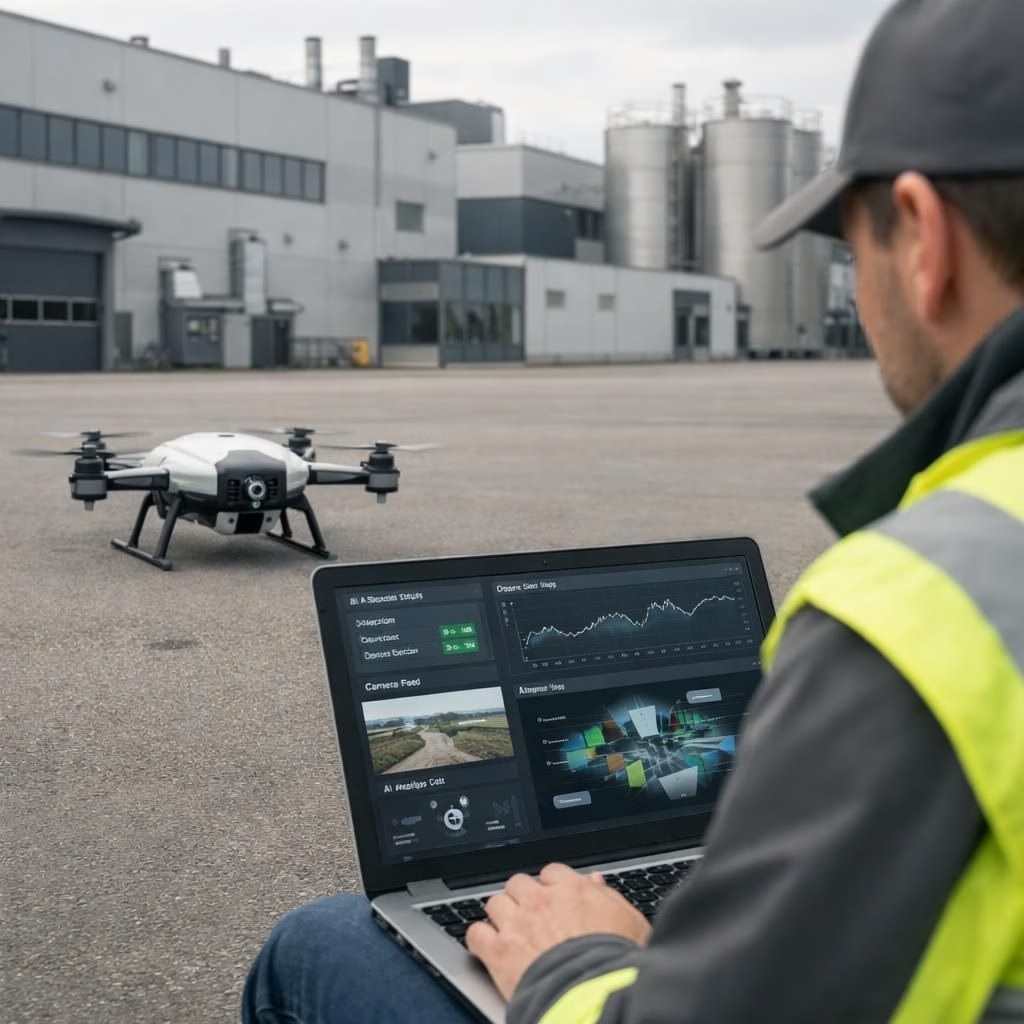
AI in Defense is reshaping how nations approach security, with the pace of change turning headlines into practical policy questions. The race involves China, the United States, Russia, and others deploying autonomous systems that turn drones into data-driven decision-makers. This is not fiction; it is a real-world shift that demands clear governance and practical Security Tips in 2026 for policymakers and engineers.
AI in Defense and Security Tips in 2026: A Forward-Look
On a public stage in Beijing, drones demonstrated autonomous flight alongside fighters, proving autonomy in the sky is now a capability, not a curiosity. This is a clear sign that AI in Defense has moved from concept to capability.
Washington officials noted that U.S. unmanned programs lag behind, while Russia has been expanding drone production facilities. Anduril, a California startup, began manufacturing AI-backed, self-flying drones at a new Columbus, Ohio, factory, three months ahead of schedule. These moves show the industrial seam between national programs and private innovation, forcing a faster cadence across the sector.
The broader arms race now spans drones that identify and strike targets with minimal human input, self-flying aircraft that coordinate at speeds beyond human reaction times, and centralized AI systems that synthesize intelligence to recommend airstrike targets quickly. The toolkit of power here stretches the limits of what we once thought machines could decide. AI in Defense is at the center of a transformation in global security, but the net is widening, with Russia, Ukraine, India, Israel, Iran, and European partners pursuing varied approaches to autonomy.
For policymakers and analysts, the challenge is not simply to celebrate or condemn these advances; it is to build standards, ethics, and governance that keep autonomy from spiraling beyond civilian control while enabling deterrence and readiness. The questions now focus on reliability, safety margins, and the human roles that must anchor decisions made by machines, as well as how to secure supply chains and protect civilian infrastructure from AI-enabled misdirection or miscalibration. Security Tips in 2026 should inform how those safeguards are designed and tested.
AI in Defense and Security Tips in 2026: A Practical Outlook for Everyday Security
The playbook is about resilience as much as speed. The human element remains essential: operators, data scientists, and policymakers must collaborate to ensure autonomy amplifies safety rather than risk.
Practical steps for organizations and individuals translate into concrete actions: secure software and hardware, demand explainable AI where feasible, implement strict access controls, and run tabletop exercises for crisis response. Security Tips in 2026 should inform how those safeguards are designed and tested. From governance to day-to-day operations, the focus is on repeatable, verifiable practices rather than one-off solutions.
- Verify supplier credentials.
- Demand explainable AI where feasible.
- Implement strict access controls.
- Practice tabletop exercises for crisis response.
- Maintain robust incident response plans.
In this context, the aim is not to stall innovation but to channel it through responsible lanes that keep humans in the loop where appropriate and deploy automated safeguards where possible.
AI in Defense: Practical Framework
To operationalize these ideas, organizations should establish red-team exercises, validate AI models in controlled environments, and diversify supply chains to reduce single points of failure. Clear accountability and ongoing training help ensure that automated systems act within acceptable risk appetites. The balance between speed and safety is where trust in AI-enabled defense tools is earned and maintained.
Security Tips in 2026: Governance and Ethics
Key themes include transparency, explainability, and robust cyber resilience. Teams should implement strict access controls, continuous monitoring, and regular audits to prevent adversarial manipulation. The field demands an ongoing dialogue about ethics and humanitarian considerations, with clear accountability for decisions made by machines.
For readers wondering how this affects them, practical takeaways involve governance: implement clear incident response plans, test AI decision loops, and ensure supply chains are diversified to prevent disruption.
International Norms and Governance for AI in Defense
As nations rearm and deter, the emphasis shifts toward cooperation, shared standards, and scalable oversight to prevent miscalculation. International norms that protect civilians and uphold humanitarian law are central to guiding AI-enabled capabilities. Ongoing debates will balance rapid innovation with public safety, transparency, and accountability in military AI programs.
For curious readers, engagement matters: share your perspectives as we navigate these times with vigilance, collaboration, and learning. The discussion extends beyond the lab into daily practice and policy development.
Original article and credit: The New York Times. A heartfelt thank you for the compelling reporting that informed this rewrite. Original article link: https://www.nytimes.com/2026/04/12/technology/china-russia-us-ai-weapons.html.
References
- Original New York Times article
- National AI Initiative (ai.gov)
- UN robotics and autonomous weapons guidance
- Artificial intelligence and national security — Brookings