

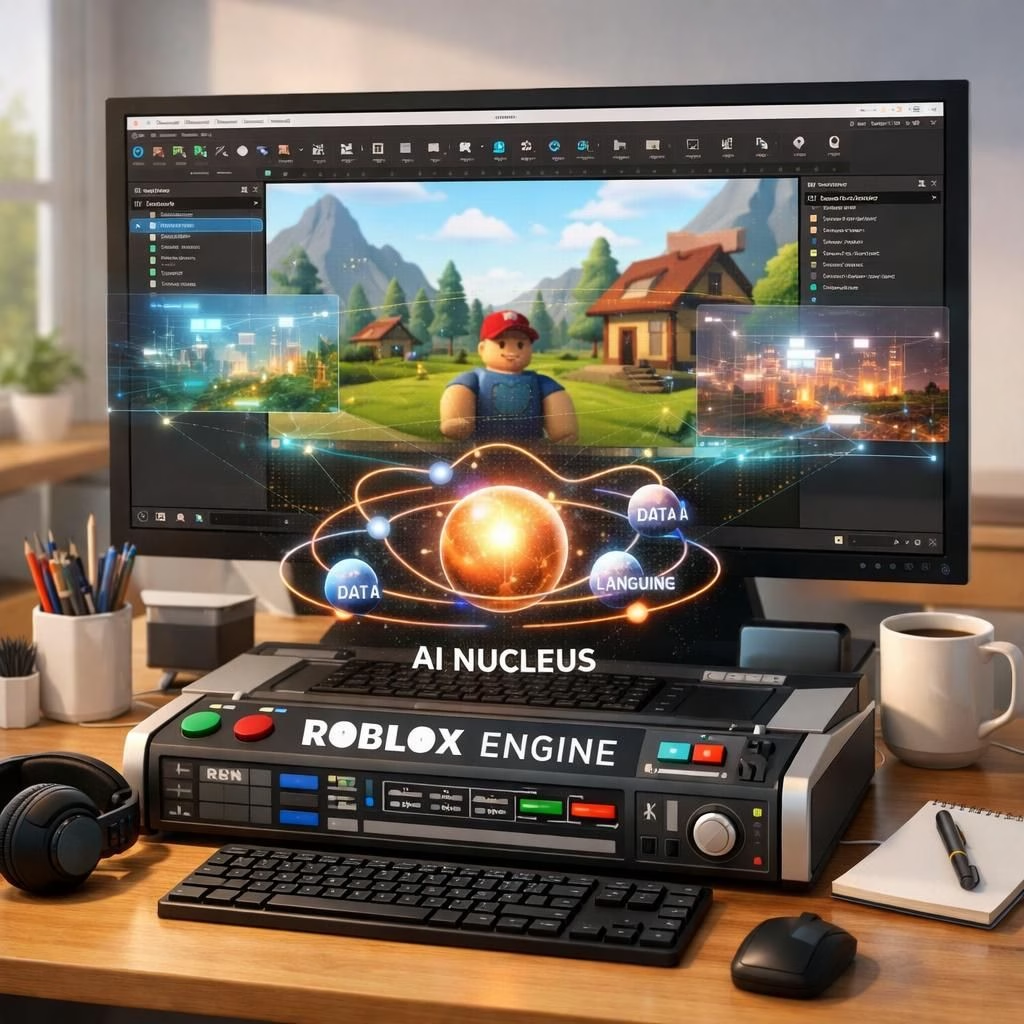
Welcome to the era of Roblox Reality and Self Forcing, where Morpheus AI, Dynamics Lab, and Lucid AI join forces to rethink how players build and explore in real time. The goal is ambitious: fuse Morpheus AI’s pixel-latent world models with Roblox Engine’s deterministic logic to deliver 4K/60Hz, multi-user photoreal worlds. This is the kind of progress you’ll want to discuss over your morning coffee in 2026 as the ecosystem doubles down on play and precision.
Roblox Reality: The Hybrid Vision
Roblox Reality is more than a brand—it’s a hybrid architecture that layers high-fidelity video visuals on top of a robust, multiplayer-ready foundation. Morpheus AI brings pixel-latent world models with autoregressive generation, while the Roblox Engine provides deterministic logic and synchronized state across players. The Self Forcing breakthrough by Xun Huang accelerates the move from slow offline generation to near-instant interactive loops. The objective is real-time 4K/60Hz experiences that feel consistent whether dozens or hundreds of players log in. Edge GPUs and advanced KV compression help trim latency and data footprint. The focus extends beyond visuals to reliability and predictable progression for shared worlds. Roblox Reality aims to raise visual quality while lowering the friction between what players see and what the server computes.
The hybrid approach also addresses a core question: how do you keep long-term memory and structured input in a vast, evolving world? The answer lies in the collaboration between the video-world models and the engine’s symbolic logic, enabling teams to scale creative ideas without sacrificing consistency.
Self Forcing: The Engine Behind Real-Time Interaction
Self Forcing, developed by Xun Huang and the Morpheus AI team, transforms sluggish offline video models into fast autoregressive engines that respond in real time. This is not magic; it’s a disciplined recipe focused on end-to-end latency, memory management, and tight feedback loops. With Self Forcing, a live world can interpret prompts and inputs with high fidelity while staying stable. Roblox and its partners view this as a way to empower creators without forcing them into a maze of micro-optimizations. In plain terms: your prompts become playable scenes in seconds, not minutes. Dynamics Lab provides real-time world-generation capabilities, while Lucid AI adds deterministic game logic to keep experiences grounded and fair. This triad opens the door to scalable, interactive world creation on Roblox Reality.
Within this effort, the team is exploring how long-context world models can sustain coherent visuals and behavior as scenes grow. The pursuit includes memory-efficient representations and predictable progression so players can rely on consistent rules, even as groups grow larger and more diverse.
Roblox Reality in Edge and Engine Harmony
Edge data centers powered by H200/B200-class GPUs enable 4K/60Hz streaming and real-time updates at scale. The integration fuses Morpheus AI’s world models with the Roblox Engine to deliver a synchronized, multi-user environment where visuals update quickly and consistently. The architecture aims to minimize lag while maximizing memory efficiency. Creators can layer richer textures, more realistic lighting, and responsive physics onto the structured world. The result is a more immersive Roblox Reality that invites players to collaborate, explore, and create together. This is not a gimmick; it’s a practical step toward reliable, scalable photoreal multiplayer.
What this means for creators and players is clearer latency, more consistent experiences as scenes scale, and higher visual fidelity without compromising game logic. For developers, the architecture reduces the need to chase low-level optimizations forever, so teams can focus on storytelling, level design, and engaging gameplay loops. For players, it translates to smoother motion, fewer frame drops, and more convincing physics. The promise of Roblox Reality is not just beauty; it’s reliability and trust in a shared world you can count on with friends.
We’re at the start of a long journey powered by hard engineering: optimized data paths, clever compression, and disciplined memory usage. The cross-pollination from Morpheus AI, Dynamics Lab, and Lucid AI creates a talent-dense environment that accelerates progress beyond what any single studio could achieve. The result could redefine how mass participation in virtual spaces works, especially when latency matters as much as aesthetics. If this sounds like science fiction, it’s because the future is being built brick by brick, frame by frame, at a 2026 pace.
We’ll keep you posted as these technologies evolve, and we’ll share updates as Roblox Reality unfolds. If you’re building or playing in these worlds, you’ll notice shifts in texture detail, lighting realism, and the feel of responsive interactivity. The blend of video world models with a deterministic engine is a practical recipe for placing people inside the same moment in time, even when players are miles apart. Roblox Reality, backed by Self Forcing, is not just a dream—it’s a plan in motion designed to scale with the community.
In closing, the momentum behind Roblox Reality and Self Forcing signals a new era of creative collaboration. Latency, consistency, and quality remain the three pillars guiding progress. For players, this means richer scenes with fewer compromises; for developers, a more productive pipeline and fewer headaches when turning ambitious ideas into experiences. We’re excited to see how studios, creators, and players respond as these technologies roll out in 2026 and beyond. And yes, the best part is you’ll be able to try them, critique them, and help shape the next wave of interactive AI in Roblox.
Original article: Founders From Morpheus AI, Dynamics Lab, Lucid AI Make Playable Photorealistic Roblox World Models Possible. Thank you to Anupam Singh and the engineering team for the source material. Please share your thoughts in the comments.
Internal references and further reading can help you map this journey. For memory-focused design ideas, see Dreaming: Better memory for a more helpful ChatGPT.
FAQ
- What is Roblox Reality? A hybrid system that combines Morpheus AI’s video-world models with Roblox Engine’s deterministic logic to support large-scale, photoreal multiplayer experiences.
- How does Self Forcing improve latency? It streamlines the generation pipeline and memory management to enable near-instant, interactive prompts while preserving stability.
- Why edge computing matters here? Edge data centers reduce round-trip times and keep visuals in sync across regions, essential for 4K/60Hz multiplayer play.
- Where can I learn more? Check the Roblox Developer Hub for engine details and the arXiv paper on world models for technical context.
Practical steps for creators
- Start with a small scene and test real-time prompts using a basic world model.
- Layer textures and lighting progressively, watching for stability as players join from different regions.
- Experiment with deterministic game logic to ensure predictable progression and fair play.
Takeaway: Roblox Reality represents a collaborative push toward high-fidelity, real-time, multiplayer worlds where latency, consistency, and quality align to empower both creators and players.