

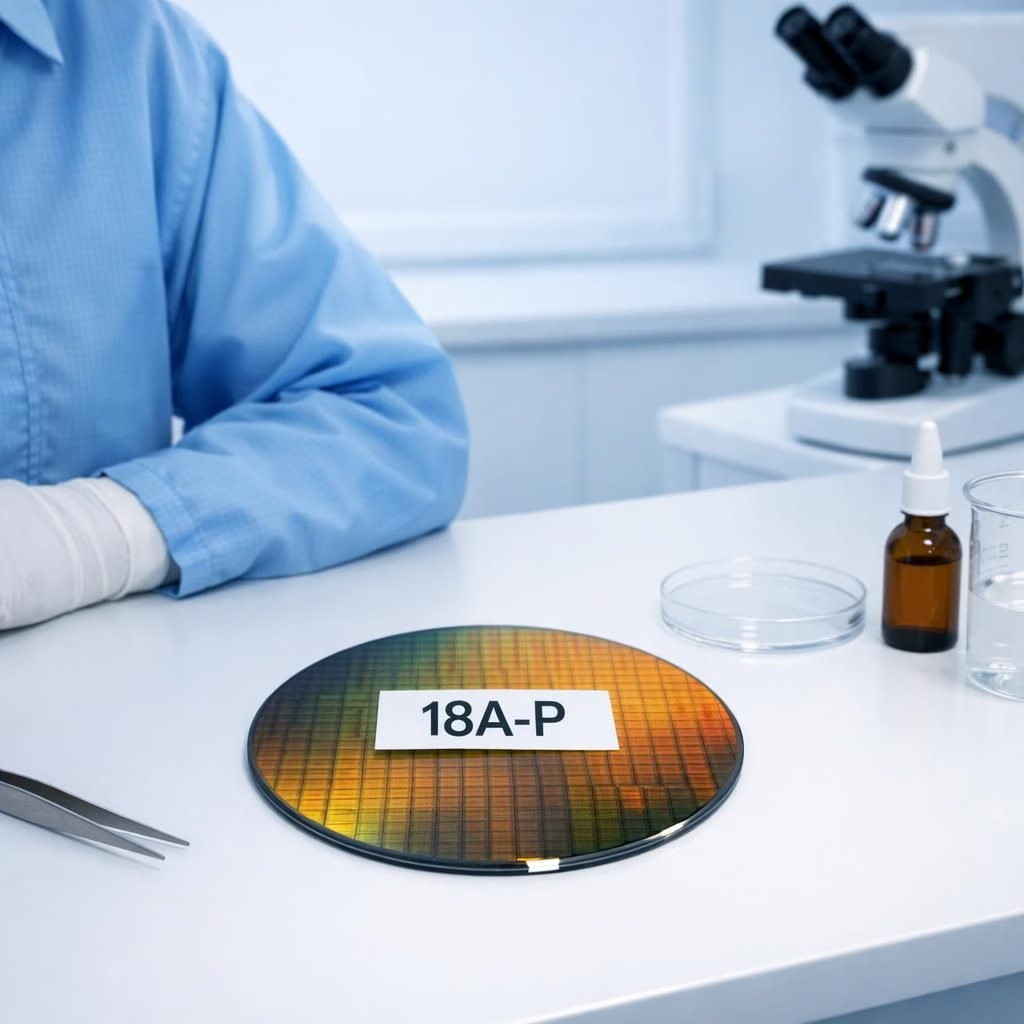
Intel 18A-P represents a milestone in chip manufacturing with risk production underway ahead of broad availability. Announced at the 2026 VLSI Symposium, the 18A-P adds the first major performance boost on Intel’s 18A node. It offers designers a choice: sprint to speed or sip power without forcing a redesign.
Intel 18A-P and chip manufacturing: Why the numbers matter
On paper, the benefits are precise. Intel quotes 9% higher performance at the same power, or 18% lower power for the same performance, when compared to the base Intel 18A process. In terms of process optimization, this expands the design space: a gaming PC can push for higher clock speeds, while a business notebook can prioritize longer battery life. And because it’s a matter of process engineering, both goals can be addressed on the same node, using the right balance for each product.
Thermal performance is where the 18A-P story gets more compelling. Reports indicate 20 to 40% better thermal resistance, meaning chips run cooler under load and can sustain higher clocks longer before heat throttling. For AI inference, data centers, and high-frequency computing, cooler operation translates into fewer throttles and steadier performance over time. That matters in a field that constantly weighs speed against cooling demands.
Intel 18A-P and chip manufacturing: Practical gains for builders
Inside the 18A-P, the core enabler is Power Boost, a dual-contact, low-resistance transistor option that increases drive current without swelling capacitance. In lay terms, you squeeze more speed where it counts and avoid a power spike that stresses the silicon. Intel also reports that vertical interconnect resistance has been reduced by 10–30% through geometry and materials improvements, which means faster signals and less energy wasted as heat across chip manufacturing pathways. When you sum these changes, the process becomes friendlier to high-frequency operation while keeping power budgets sane.
Backward compatibility is a standout feature. The 18A-P remains fully design-rule compatible with 18A, so existing chips, IP blocks, and tooling can be reused without a redesign. The process retains the same two cell heights, 180 nm and 160 nm, which reduces migration friction for teams upgrading to a newer node without a costly rebuild. For companies that already invested in 18A designs, this compatibility translates into lower costs, shorter timelines, and a smoother path to the improved performance and efficiency promised by the 18A-P upgrade.
Beyond the immediate production upgrade, Intel Foundry’s VLSI reveal hints at a broader trajectory for chip manufacturing. CFET transistors, demonstrated as monolithic inverters with vertically stacked NMOS and PMOS devices at a 45 nm gate pitch, show where stacking and integration can enable new options. GaN-on-silicon power devices on 300 mm wafers, including a digital control block of about 1,000 gates, illustrate how power and logic can be tightly co-located. Subtractive ruthenium interconnects with air-gap integration offered up to a 35% reduction in capacitance versus copper interconnects. These results aren’t decisions today, but they map a plausible route for the industry to keep advancing over the long term.
Intel 18A-P and chip manufacturing: The road ahead
For chip manufacturing teams, the 18A-P upgrade represents a steady, predictable path forward. The improvements reduce migration costs and shorten time to first samples, while delivering tangible gains in performance and efficiency. The industry should watch how CFETs, GaN on silicon, and ruthenium interconnects converge with mainstream production, because that convergence could redefine how we design, fabricate, and power tomorrow’s chips. In the broader ecosystem, this progress invites curiosity, debate, and healthy skepticism—factors that keep the field honest.
Original article attribution: Thank you to the Times of India for comprehensive coverage of Intel 18A-P. You can read the original Times of India article here: Times of India.
What do you think about the 18A-P upgrade and its implications for chip manufacturing? Share your thoughts in the comments below.
Practical steps for designers
- Assess current IP for 18A compatibility and identify modules that can reuse base designs on 18A-P with minimal changes.
- Evaluate the 9% performance or 18% power savings trade-offs for target workloads (gaming vs. productivity).
- Plan a migration path that minimizes risk and avoids simultaneous, large-scale redesigns.
- Incorporate enhanced thermal and power-management strategies to harness higher clock speeds safely.
Frequently asked questions
- What is 18A-P? It is a performance- and power-optimised extension built on Intel’s 18A process node, designed to deliver higher speeds or lower power at the same performance.
- Is 18A-P backward compatible? Yes. Intel notes full design-rule compatibility with 18A, enabling reuse of existing designs and tooling without redesign.
- When will products ship? Intel has stated that risk production is underway, with full commercial deployment timing not announced yet.
- Why are CFETs and GaN-on-silicon significant? They represent avenues for continued scaling and integration of power and logic, potentially enabling new performance envelopes.