

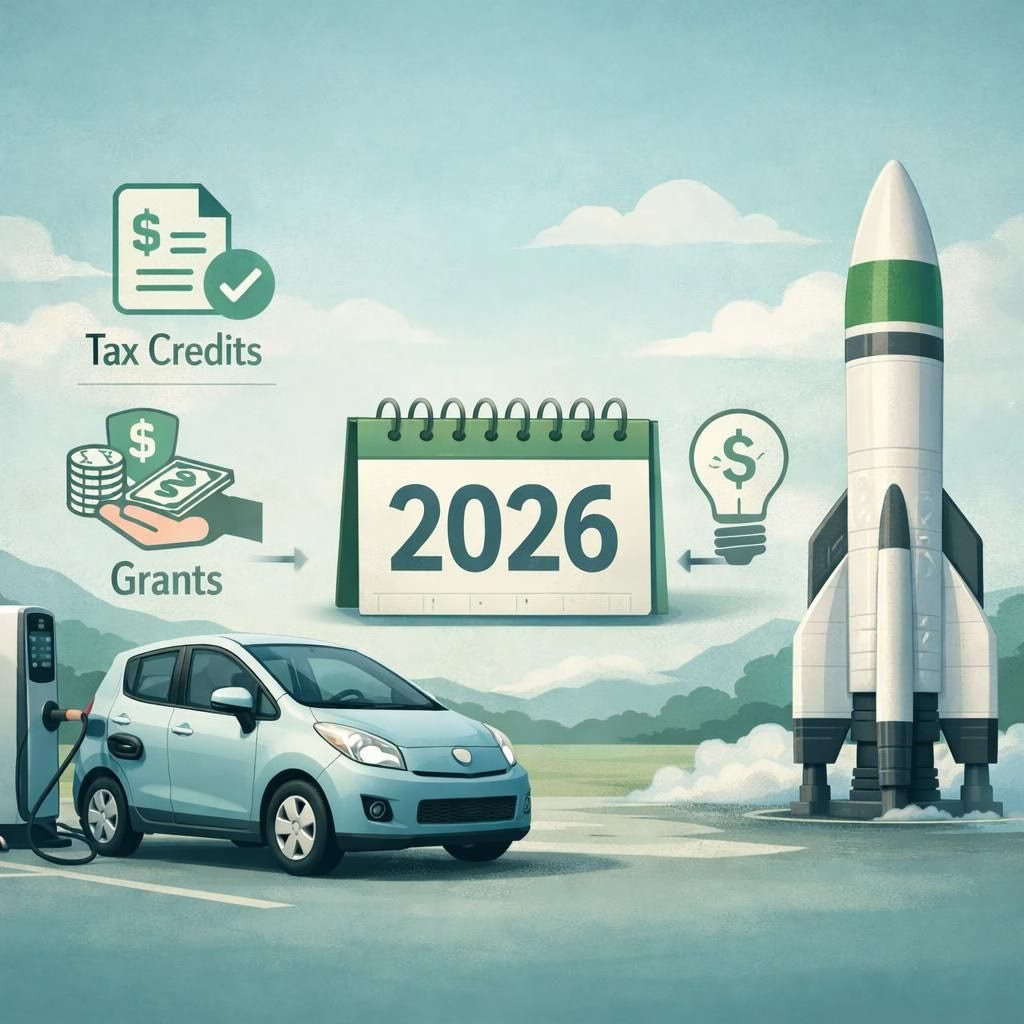
Here’s a cheerful reminder that economics and storytelling aren’t adversaries. The online chatter about who owes whom money tends to swing between dramatic headlines and dry footnotes. In 2026, the debate over government support and startup success concerns people from Main Street to the factory floor. The protagonists include Elon Musk, Tesla, and SpaceX—three names that spark both admiration and scrutiny. The conversation often frames wealth as a single determinant: money from taxpayers equals power for a few. But reality is messier, filled with incentives that come in many shapes, from research grants to tax credits to loan guarantees. The claim that government incentives alone built the empire is not credible, but the claim that incentives never mattered is also false. This post reorients the discussion with a hopeful tone, showing how policy, capital, and entrepreneurial grit interact. We’ll start by checking Musk’s assertion: less than 2% of value comes from incentives, a figure that begs careful unpacking rather than celebration or scolding.
Elon Musk and Tesla: What the numbers actually say about government incentives
When the numbers come up, people reach for the simplest story: government money creates the magic. In reality, the figure Musk cites—less than 2% of value from incentives for SpaceX and Tesla—depends on what you count. If you tally only direct cash subsidies, you miss the subtler forms: tax credits that shift demand, research credits that lubricate R&D, and loan guarantees that lower financing costs. Tesla is often cited as a beneficiary of policy; SpaceX is cited as a beneficiary too. Yet the same incentives also flowed to many other players who still failed to reach the moon in reality and in markets. The point isn’t to claim victory for subsidies but to acknowledge that policy helped certain capabilities reach escape velocity, not to hand over a blank check to any company.
In public debates, a lot rides on how we measure value. Public incentives can push a company toward longer-term bets that private capital alone might overlook. For example, the EV tax credit, which some versions claim as a giveaway, also creates a predictable demand curve that helps startups scale. Tesla benefited when policy signaled a broader market for clean vehicles, but SpaceX and Elon Musk’s engineering team improved the odds through relentless iteration, cost discipline, and bold decisions. In short, Elon Musk is right about the need for nuance; Tesla did leverage incentives, but those incentives did not write the entire success story, nor did they exhaust the contribution of founders and teams.
SpaceX and the policy-rocket balance: Tesla angle in incentives
SpaceX, the other half of the SpaceX-Tesla triangle, has a similar origin story in the public policy arena. SpaceX benefits from government contracts, and its ability to win contracts is itself a product of deliberate engineering choices, rigorous testing, and disciplined cost control. Critics point to subsidies; supporters note that SpaceX’s launch cadence and reusability breakthroughs created a market that otherwise would have remained speculative. The result is not a fairy tale of freebies; it is a pragmatic narrative about how policy, procurement, and private-sector entrepreneurship can align to reduce launch costs and advance space exploration. When senators spar about taxpayer money, the real takeaway is that SpaceX’s success rests on a mix of policy signals, private capital, and a culture that treats failure as a step toward the next upgrade. And yes, Elon Musk keeps showing up—sometimes as the ringleader, sometimes as the skeptic in the mirror.
In this light, the debate suddenly feels less rancorous and more instructive. The subsidies are part of a larger ecosystem: a policy framework that encourages risk-taking, a capital market that rewards growth, and a leadership team that refuses to treat failure as a personal insult. Musk’s point that incentives are not the sole determinant holds true for both Tesla and SpaceX. Yet it’s equally true that incentives—whether tax credits, R&D credits, or loan guarantees—helped accelerate technical milestones, from battery chemistry to reusable rockets. The result is a more optimistic view: policy nudges, not puppeteers; entrepreneurs lead, investors judge, and the market learns faster when the rules align with creative ambition.
Two practical takeaways about incentives, markets, and the real world
First, incentives are a complicated but real part of tech progression. They shape the pace of development and the shape of competition, but they do not erase the value of talent, leadership, and execution. For Elon Musk and his teams at Tesla and SpaceX, the science remains the star—policies simply help set the stage. Second, the numbers matter, but how we tell the story matters more. When we say less than 2%, we should also explain what’s included and what’s left out. And when we cite market reactions—like Tesla shares rising after the EV tax credit changes—we should connect that reaction to broader strategic choices: expanding product lines, improving manufacturing efficiency, and building a brand that can weather policy oscillations. In short, policy is a tool; the people behind the machines still drive the outcome.
Elon Musk: navigating policy and product strategy
That navigator role is where leadership meets policy. The entrepreneur’s drive remains the core engine, while incentives provide a smoother runway. Tesla teams have repeatedly shown how product design, manufacturing discipline, and relentless testing convert policy pressure into real, lasting gains. The result is a more resilient business that can adapt when rules shift.
SpaceX and the policy-rocket balance: Tesla angle in incentives
Two practical takeaways apply here as well: policy nudges guide risk-taking, and private capital rewards disciplined execution. SpaceX’s trajectory illustrates how procurement can stimulate credible demand for rockets and related services, while Tesla-like momentum can emerge when technology, finance, and policy converge.
Practical takeaways: incentives, markets, and the real world
- Incentives matter, but they don’t replace talent, leadership, and execution.
- Policy should align with ambitious product roadmaps and manufacturing efficiency.
- Clear rules and predictable incentives help startups scale and investors evaluate risk.
FAQs
- Do incentives create wealth, or do entrepreneurs create wealth?
Entrepreneurs turn ideas into products, while incentives help unlock risk-bearing capital and speed development. Neither alone tells the full story.
- Did government subsidies guarantee success for Tesla or SpaceX?
No. Subsidies are not guarantees; they support specific decisions and risks, not outcomes.
- What happened to the EV tax credit in practice?
Policy changes can shift consumer demand, but companies still compete on product, price, and quality. The long-run effects depend on execution and market adaptation.
- Can other sectors learn from this?
Yes—policy, capital, and leadership work best when aligned with long-term product development and operational discipline.
We invite readers to share their thoughts in the comments. How do you weigh the role of policy against the craft of engineering and the grit of entrepreneurship? Do you believe government incentives helped or hindered the progress of Tesla and SpaceX? Your perspective matters, and a lively, respectful debate makes us all wiser.
Special thanks to the original article for material and context. If you’d like to read the source that inspired this post, you can visit the original piece here: How much of Musk’s money comes from government help? Virtually all of it. Thank you for the thoughtful reporting and the springboard for this discussion.