

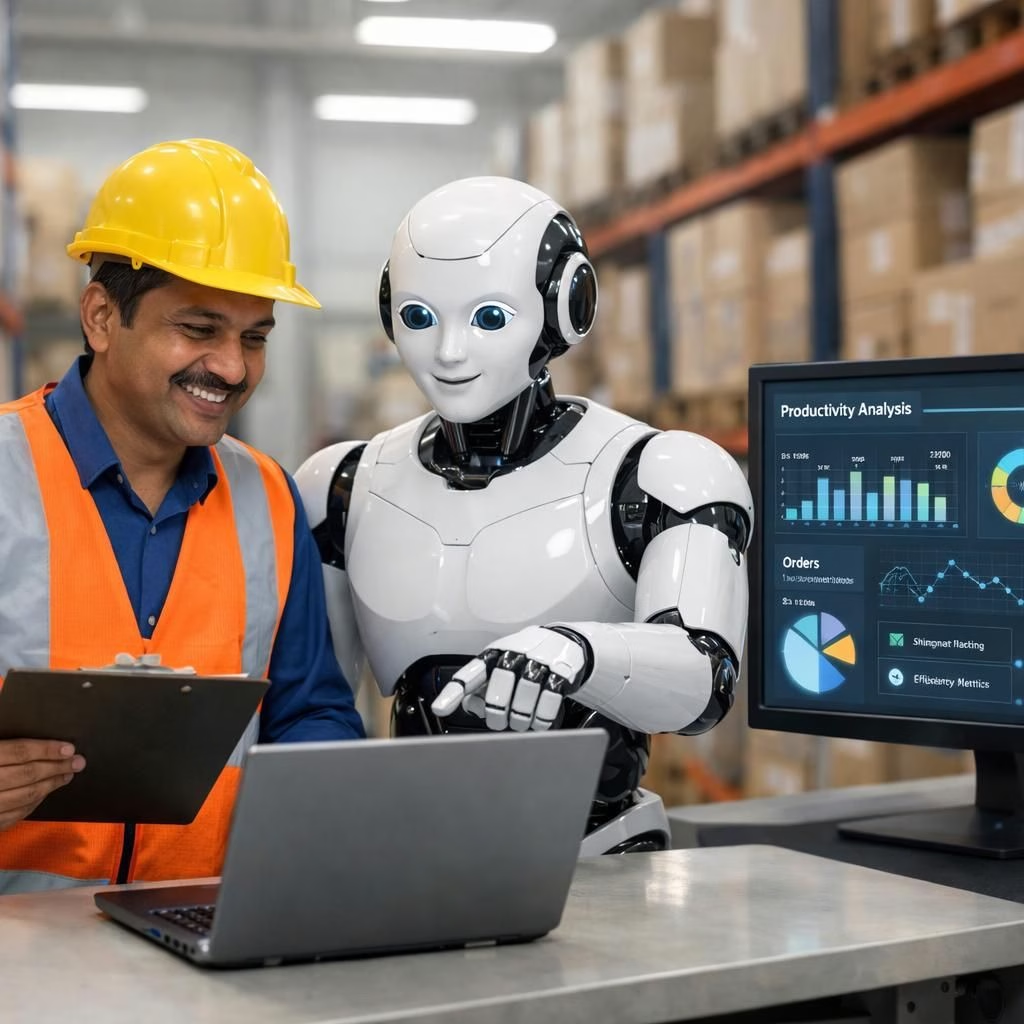
भारत की तकनीकी यात्रा अब AI और Robotics के साथ एक नए अध्याय की ओर बढ़ रही है. इंडिया AI Impact Summit 2026 में Qualcomm ने AI-powered humanoid Robotics platform का अनावरण किया — एक व्यावहारिक झलक जो बताती है कि कैसे AI इंसानों के साथ मिलकर लॉजिस्टिक्स, मैन्युफैक्चरिंग और रिटेल ऑटोमेशन में काम कर सकता है. यह प्लेटफॉर्म तेज, सुरक्षित और स्मार्ट संचालन का वादा करता है, ताकि शिफ्ट शुरू होते ही रोबोट भरोसेमंद सहयोगी बनें. AI डेटा को वास्तविक समय में समझकर निर्णय लेता है और Robotics उन निर्णयों को क्रिया-रूप में बदलते हैं.
AI in Indian Industry: A Friendly Update
AI in Indian industry is not mere fancy on a whiteboard; it makes a practical upgrade in factories and storefronts. Qualcomm’s platform uses sensors, edge AI, and adaptive decision-making to map the workspace: aisles, pallets, humans, and machines all talking in a shared language.
In warehouses, Robotics-enabled systems lift, sort, and stack goods with precision, reducing misreads and fatigue. The human workforce gains time to troubleshoot, plan, and steer progress. Production lines become smoother as AI helps with scheduling, quality checks, and anomaly detection. The blend of AI and Robotics yields safer, faster throughput and better resource utilization, turning tough KPIs into achievable milestones. This is not sci‑fi; it’s a practical toolkit that respects human hands while magnifying human thinking, with AI as the steady partner ensuring decisions stay data-driven.
Robotics at the Core: From Warehouses to Retail
Robotics sits at the core of this industrial renaissance. These humanoid platforms and companion Robotics carry out repetitive tasks that used to drain energy and raise error rates.
In the logistics space, Robotics-powered systems lift, place, and sort items with a consistency that managers appreciate. In manufacturing, robotics-enabled assembly lines perform precise operations with minimal downtime, while AI keeps the robots focused on quality. In retail automation, Robotics can greet customers, locate items, and assist with inventory management, freeing staff for service and strategy. The Robotics stack is designed to adapt to India’s vibrant, often chaotic retail environments, with robust sensors, safety features, and a learning loop that improves with every shift. This is automation that respects the pace of Indian workplaces while teaching machines to read the room—literally and figuratively.
From an economic standpoint, the 2026 rollout is positioned to boost productivity and attract AI and Robotics R&D investment across India. The synergy promises lower production costs, shorter lead times, and resilience against demand swings. Rather than replacing people, the approach emphasizes augmentation: AI analyzes patterns so humans can apply creativity and judgment where it matters, while Robotics handles repetitive, precision-based tasks. The result is a more resilient supply chain, a more agile manufacturing footprint, and a retail operation that can scale without losing the personal touch customers expect. This is grounded optimism, as real value comes from turning ambitious plans into reliable practice on the factory floor and the storefront alike.
Business leaders should start small, measure often, and grow with intention. Pilot programs that couple AI analytics with a narrow set of Robotics-enabled tasks tend to deliver the fastest payback. Consider AI-assisted inventory checks, Robotics-driven sorting in a warehouse, and AI‑aided quality control on a pilot line. When building a roadmap, plan a gradual expansion of AI and Robotics integration, while keeping safety, compliance, and workforce training at the center. The real win comes from a culture that treats intelligent machines as teammates who accelerate learning, not replace it. AI helps with forecasting and decision support; Robotics handles execution and consistency; together they form a partnership that respects human workers and invites them to lead in areas where creativity and empathy matter most.
As we step into 2026, the conversation shifts from fear of automation to curiosity about augmentation. The Qualcomm platform is a practical tool for India’s manufacturing corridors, logistics hubs, and retail floors. AI guides planning; Robotics executes with accuracy; and the result is a system that adapts to varied environments—from crowded warehouses to busy street-front stores—while maintaining safety and efficiency. The pairing of AI and Robotics has the potential to redefine how Indian businesses operate, enabling smarter decisions, faster iterations, and a more dynamic economy. The journey may be long, but the first mile looks promising with AI insights and Robotics precision at every turn.
With this milestone, India edges closer to becoming a global hub for AI and Robotics innovation. Startups may build specialized tools for logistics agility; manufacturers could accelerate modernization programs; retailers might deploy smarter shelf management and customer service assistants. The shared thread is clear: AI translates data into actionable plans, and Robotics translates those plans into tangible results, day after day. The result is a more resilient industrial ecosystem that can weather fluctuations, scale responsibly, and keep people at the center of progress—even as machines quietly do the heavy lifting alongside them.
As a closing note, the excitement around the 2026 India AI Impact Summit signals that AI and Robotics can cooperate in practical, scalable ways that respect human expertise while unlocking new efficiency levels. The path forward includes workforce training to collaborate with machines, governance that prioritizes safety and ethics, and ongoing R&D to refine interfaces and decision‑making. If you’re a business leader, a developer, or a curious reader, this is a moment to observe, participate, and imagine how AI and Robotics can shape your industry—with pragmatism, clarity, and a touch of audacity.
Original article attribution and gratitude: Special thanks to Country Times Bihar for the original material and inspiration. Read their coverage and acknowledge the thoughtful reporting that helped shape this perspective: Original article from Country Times Bihar.
Practical Pathways for AI and Robotics Adoption
- Start with a narrow pilot: AI analytics paired with Robotics-enabled inventory checks in a single warehouse.
- Choose a controlled environment: a single shift, limited SKU complexity, and shared safety protocols.
- Integrate sensors and edge AI to map aisles, pallets, humans, and machines in real time.
- Define clear KPIs: accuracy, throughput, safety incidents, and worker training time.
- Plan scale-up: gradually broaden the scope to more processes and sites while maintaining governance.
FAQ: AI and Robotics in India
- 1. What is the India AI Impact Summit 2026?
- A national event showcasing AI-driven solutions across industry sectors, with a focus on practical deployment and policy alignment.
- 2. Will AI and Robotics replace jobs?
- Principle use is augmentation: machines handle repetitive tasks while people focus on design, problem-solving, and customer service.
- 3. Which sectors benefit most?
- Logistics, manufacturing, and retail automation see the fastest gains in efficiency, safety, and customer experience.
- 4. What should businesses consider before starting?
- Define a narrow scope, invest in safety training, ensure data governance, and measure impact with practical KPIs.
Conclusion with a pragmatic takeaway
The Qualcomm AI humanoid platform marks a pragmatic shift: AI informs planning while Robotics executes with precision. For India, the path to becoming a global hub for AI and automation lies in deliberate pilots, ethical governance, and continuous learning by both people and machines.
References
Source linkback: https://deshajtimes.com/news/technology/qualcomm-ai-humanoid-robot-india-summit-2026/230475/