

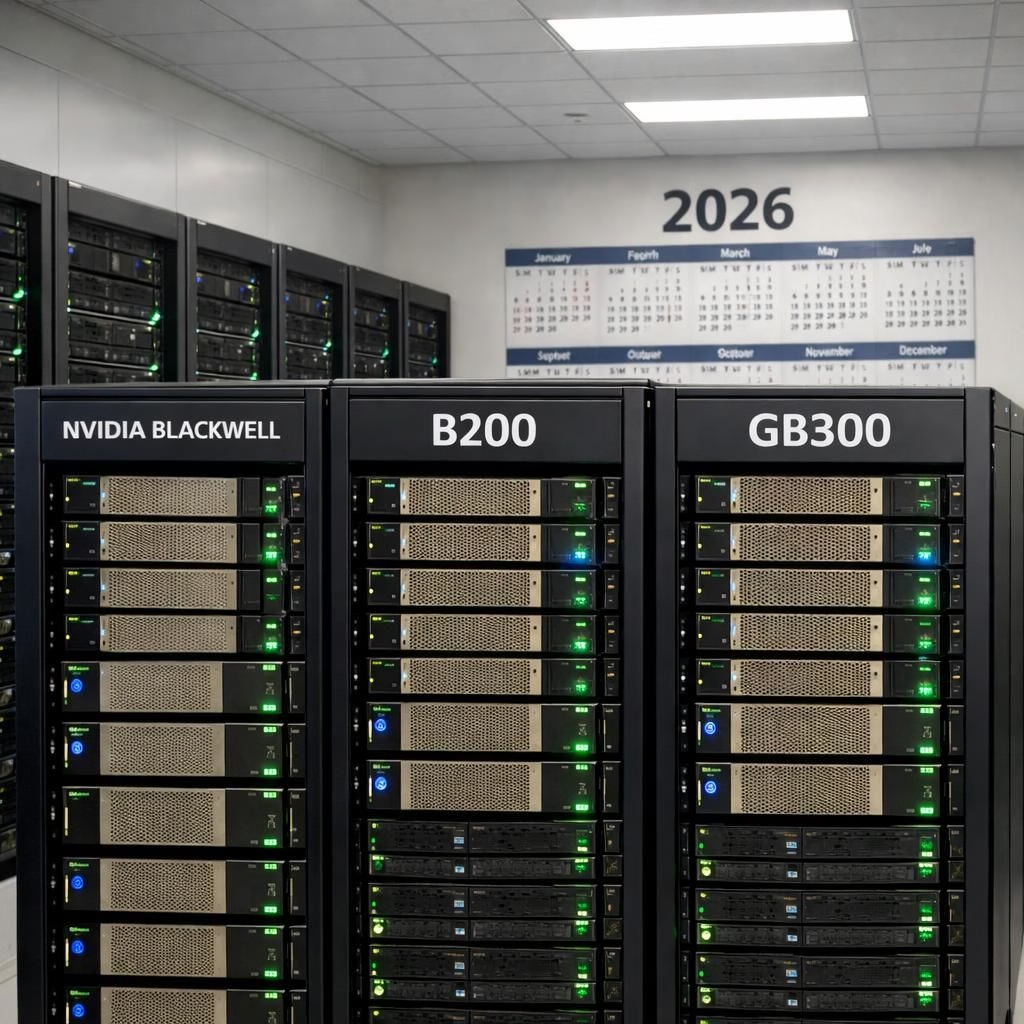
Bengaluru-based Yotta Data Services is a data centre and AI infrastructure provider. It unveiled a bold $6 billion expansion to turbocharge GPU deployment for global and Indian clients. The plan centers on Nvidia’s Blackwell GPUs, alongside 8,000 B200s in the near term and a careful eye on next‑generation GB300 or Vera Rubin units for 2027. In plain terms, this is Yotta doubling down on capability while keeping the lights on for government agencies and multinational AI teams alike. If you’re keeping score, this is not a hobbyist upgrade: it’s a full‑throttle scale‑out that future‑proofs the supply chain and reduces dependence on any single supplier.
AI infrastructure leads Yotta’s growth plan
The leadership stresses that AI infrastructure readiness will empower customers to reach new AI milestones. The first wave includes 8,000 B200 GPUs going live within a month, a concrete step in the GPU deployment plan that shows the pace at which the company wants to move. The existing 20,000 Blackwell GPUs are slated to be operational by September, with an additional 10,000 Blackwells coming online by November, and the GB300/Vera Rubin lineup eyed for a May next year rollout. This expansion relies on pre-contracted capacity and long‑term revenue visibility to attract financing, a prudent approach in today’s capital markets and a signal to lenders that ambition is matched by discipline.
GPU deployment momentum: Blackwell to Vera Rubin on a fast track
The GPU deployment momentum is the headline, with 30,000 Blackwell GPUs now envisioned, up from 20,000. The near-term 8,000 B200 GPUs represent a dedicated investment around $600 million. The plan emphasizes off‑book financing where global investors own the assets and Yotta operates the infrastructure, sharing revenue from four‑ to five‑year take‑or‑pay contracts. All GPUs are pre-contracted, guaranteeing that capacity can be delivered as soon as four months from signing, which translates into reliability for multinational clients and a smoother path to project execution. In this setting, the GPU deployment tempo isn’t a gimmick; it’s the scaffolding for a broader AI agenda that aims to empower sovereign AI programs and commercial models alike.
The expansion also projects a longer‑term horizon, with a rollout of GB300 or Vera Rubin GPUs targeted for May next year. If the first phase proves robust, there’s a reasonable expectation that the capacity could scale further in 2027 to meet growing demand from both Indian and international clients. By tying capacity to fixed commitments, Yotta aims to reduce revenue volatility and create a platform that can sustain large training pipelines and real‑time inference at scale.
To fund this sprint, Yotta uses an off‑book financing model that keeps the balance sheet lean while allowing investors to own the GPU assets and the company to operate the infrastructure. The long‑term take‑or‑pay agreements provide pre‑defined buyer commitments for four to five years, delivering predictable cash flows for lenders and stable pricing for customers. Gupta stresses that these GPUs are already contracted; legally, the capacity exists even if the on‑ground delivery dates shift by a few months, which adds a healthy layer of reliability to the project plan. That clarity helps maintain the GPU deployment timeline in lockstep with client expectations.
Beyond the raw hardware, Yotta frames its strategy as building a robust AI infrastructure fabric rather than chasing a single big model. This distinction matters for sovereign AI initiatives, where governments want reliable compute that can support training, evaluation, deployment, and updates without bottlenecks. The company cites its two large campuses—the 2‑gigawatt Mumbai campus and a 250‑megawatt Delhi facility—and ongoing support for government workloads via NIC data centers as proof that the model can scale responsibly and transparently.
From a business perspective, about 75% of current orders come from international clients, with several US and European AI players already using Yotta’s GPU fabric for model training and deployment. The geographic mix isn’t accidental: it reflects a deliberate strategy to diversify risk, reduce single‑supplier dependency, and establish India as a global AI compute hub with a dependable export footprint. The operating thesis is simple: a diversified, globally accessible compute backbone strengthens both national ambitions and corporate partnerships while opening doors for more sophisticated sovereign AI programs.
The economics of AI infrastructure differ markedly from traditional data centers. Where a conventional facility might require about $6 million in capital expenditure per megawatt, adding GPUs can push that figure toward $40 million per megawatt. This isn’t a bug; it’s a feature that highlights why take‑or‑pay contracts and pre‑contracted capacity matter so much. They convert high upfront costs into predictable, long‑term revenue, making it easier to secure financing and keep the lights on even as workloads evolve and demand spikes.
Yotta’s governance and forecasting glow with practical optimism. The company is positioning for a public listing, with early media chatter pointing to a potential size around $900 million, while Gupta suggests that overall fundraising could exceed $1.5 billion when pre‑IPO institutional investors are included. The rationale is straightforward: a larger float supports faster expansion, helps attract top‑tier customers worldwide, and gives the company more levers to adapt to a rapidly changing AI landscape in 2026 and beyond.
As the company scales, the leadership acknowledges that this is not just a tech play but a geopolitical one as well. Securing a broad, diverse compute base reduces the risk of supply shocks that could otherwise slow critical AI initiatives around the world. India’s push to become a sovereign AI hub aligns nicely with the company’s strategy: create a trusted, transparent compute backbone that can support government needs and commercial ambitions without becoming over‑reliant on a single supplier or country.
What do you think about this GPU deployment push and its impact on the data economy? Share your thoughts in the comments below.
Original article: Times of India – original material. Thank you to Times of India for providing the source material.
Practical takeaways
- What this means for customers: access to a large, pre-contracted compute backbone that supports training and inference at scale.
- Financing model: off‑book arrangements reduce balance‑sheet risk while delivering long‑term revenue certainty for lenders and clients.
- Strategic value: building a diversified compute ecosystem helps India and global partners reduce reliance on any single supplier.
FAQ
- What is Yotta’s expansion plan? – A $6B push to scale AI infrastructure with 30,000 Blackwell GPUs and 8,000 B200s, plus next‑gen GB300/Vera Rubin units slated for 2027.
- How does the off‑book financing work? – Investors own the GPU assets while Yotta operates the infrastructure under 4–5 year take‑or‑pay contracts, providing predictable revenue streams.
- Why is this important for India? – It positions India as a sovereign AI compute hub with a diversified, trusted compute backbone for government and commercial needs.
- When will the new GPUs come online? – The first batch of 8,000 B200 GPUs should go live within a month; 20,000 Blackwell GPUs ready by September, with 10,000 more by November; GB300/Vera Rubin in 2027 if demand sustains.
References
- NVIDIA: Blackwell architecture overview
- NVIDIA: Blackwell data center architecture
- Times of India – original material