

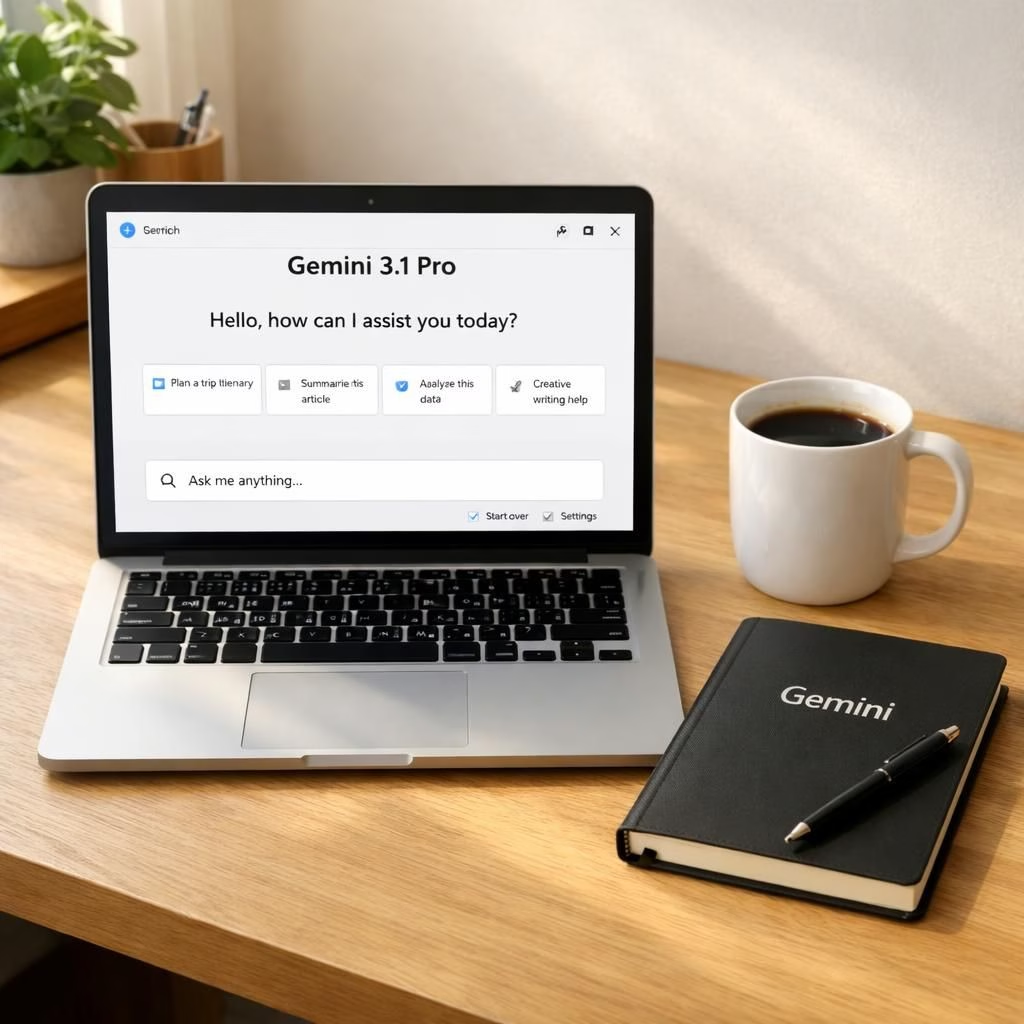
Google Gemini 3.1 Pro arrives in 2026 as a friendlier upgrade for sharper AI reasoning and tackling multi-step tasks. The update rolls out across the Gemini app, NotebookLM, and developer platforms including Google AI Studio, Vertex AI, and Antigravity. This isn’t a flashy feature parade; it’s a targeted intelligence upgrade that builds on the Deep Think engine introduced last week and brings it to a wider audience with polish and personality.
Google Gemini: Practical gains for everyday AI work
For professionals, students, and curious tinkerers, Google Gemini 3.1 Pro translates into tangible capabilities. You can stitch together large datasets into a single readable view, saving time and reducing data friction.
You can prompt the system to generate animated SVGs directly from a text description, delivering scalable visuals with tiny file sizes. Layered scientific and technical problems finally get a thorough going-over, with steps laid out in a coherent narrative rather than disjointed results.
The engine stays crisp as you zoom, scales across devices, and avoids hallucinations when nuance arrives. This update strengthens AI reasoning in day-to-day tasks.
AI reasoning in action: Gemini-powered multi-step solutions
The numbers tell a story that is hard to ignore. ARC-AGI-2 scores rose to 77.1% for abstract reasoning on entirely new logic patterns, more than doubling the previous 3 Pro’s score. GPQA Diamond (scientific knowledge) hits 94.3%, SWE-Bench Verified (agentic coding) 80.6%, and BrowseComp (agentic search) 85.9%.
On LiveCodeBench Pro’s competitive coding Elo, Gemini 3.1 Pro clocks in at 2887. In practical terms, this upgrade boosts AI reasoning across data synthesis, model-assisted coding, and quick notebook work.
Google describes 3.1 Pro as built for situations where a simple answer isn’t enough. Practically, that means synthesizing rows and charts into a digestible dashboard, or turning a plain prompt into an animated SVG that remains crisp, scalable, and compact. You’re not just getting better answers; you’re getting a traceable AI reasoning path, so you can follow each step and tweak the approach as needed. It’s like having a thoughtful lab partner who knows how to draw diagrams that stay sharp on a whiteboard or screen.
In terms of access, 3.1 Pro ships in preview while Google tests performance for agentic workflows. Consumers can try it via the Gemini app and NotebookLM, with higher usage limits for Google AI Pro and Ultra subscribers. Developers gain access through the Gemini API in Google AI Studio, the Gemini CLI, Antigravity, Vertex AI, Gemini Enterprise, and Android Studio. General availability is promised soon, with a roadmap that hints at deeper integrations into data pipelines and enterprise toolchains.
For engineers who enjoy a quick demo, the animated SVG capability is notable. Outputs are generated as code rather than pixels, meaning they stay crisp at any scale and keep file sizes modest compared with traditional video. It’s a practical feature for dashboards, teaching materials, and lightweight visualizations in notebooks, where you want clarity without bloat. The approach also showcases AI reasoning in action.
All told, the 3.1 Pro tier broadens Gemini’s core strength—reasoning across steps and domains—while preserving safety, reliability, and a touch of whimsy. It’s the kind of upgrade that makes a busy researcher nod and say, Yes that tool fits my workflow today, not in a hypothetical future. If you’re curious about how it performs in your field, you’ll find previews, examples, and best practices to help you get started, along with community tips that make the learning curve friendlier.
Have thoughts about how you’d use this upgrade in your work? Share them in the comments below. Your real-world experiences help everyone understand what works best in practice and what could use a bit more polish. We’re all learning together, one prompt at a time.