

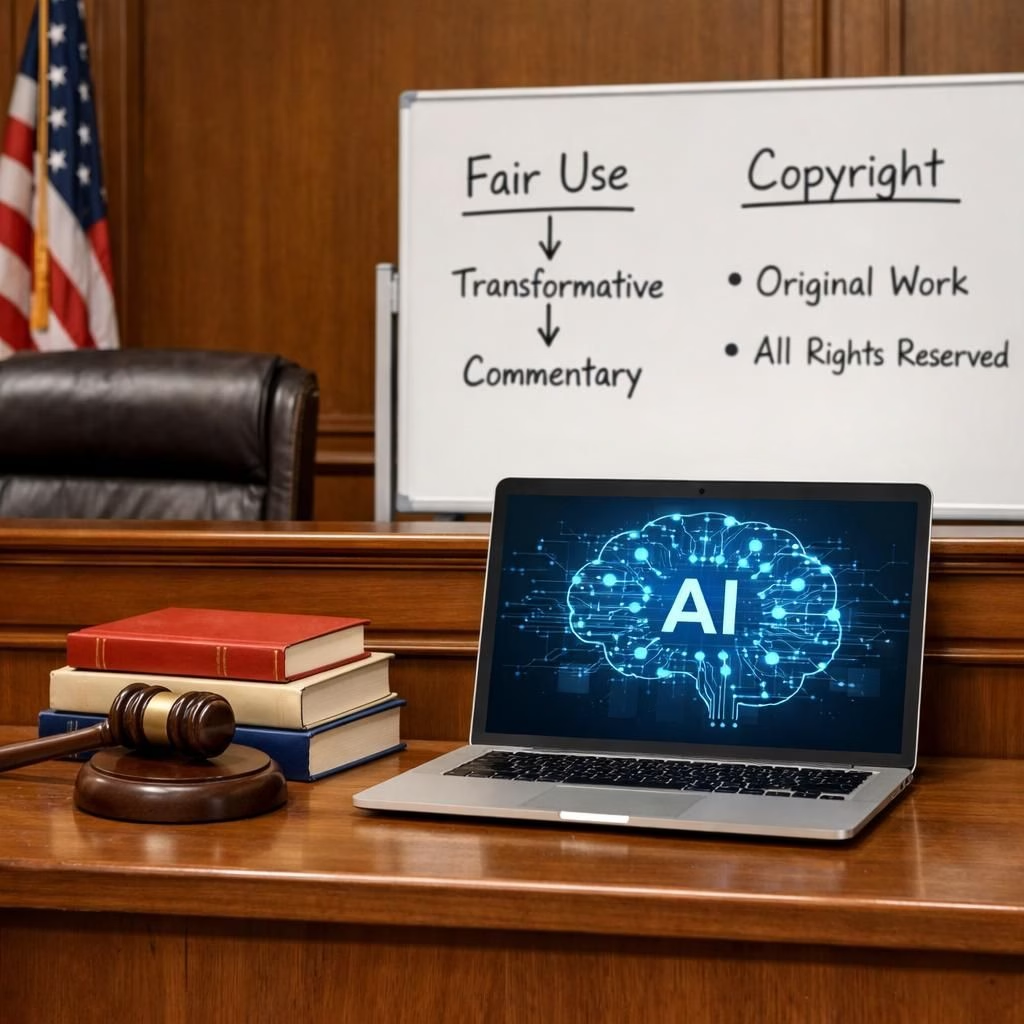
Understanding the fair-use settlement
In 2026, the saga of fair-use and copyright resilience makes headlines again. A federal judge in San Francisco gave final approval to Anthropic’s $1.5 billion settlement with authors who argued Claude was trained on pirated books. The ruling reframes the conversation about fair-use and copyright by turning a courtroom cliffhanger into a concrete settlement. This outcome balances author rights with practical AI development, grounding the debate in real dollars rather than spectacle.
The case began in 2024, when authors argued that Anthropic built Claude on their work without permission. Former Judge William Alsup laid down a line that shaped expectations. He ruled that training the model on books could be copyright — the nuance being fair-use in some contexts — but he found that Anthropic saved more than seven million pirated books to a central library that would feed the AI, a move that raised copyright concerns. A trial had been set for December to decide damages, potentially in the hundreds of billions, but the settlement removes that risk for both sides and provides a clearer path forward under the fair-use framework and copyright rules.
When the deal first reached the court, Alsup pushed back, warning that the terms could feel like they were being forced down authors’ throats and called the agreement nowhere close to complete. Anthropic responded by creating a public website listing the affected works so writers could check whether they qualified. The settlement covers more than 480,000 titles, and rights holders filed claims on over 92% of them, signaling broad market acceptance of the structure that intertwines fair-use expectations with copyright protections.
copyright considerations for training data governance
After Alsup retired, Judge Martinez-Olguin took over and approved the terms. She rejected complaints about the payout size, saying they were not grounded in a realistic assessment of the trial’s overall risks and rewards. Plaintiffs’ attorneys were awarded more than $101 million of the $187.5 million they had requested. Some authors and publishers opted out and are pursuing their own suits, which remain active. The decision doesn’t erase disputes, but it creates a predictable framework around fair-use and copyright considerations for future AI training projects.
Anthropic framed the outcome as validation. “We reached this settlement in 2026, after the court’s landmark ruling that training AI on books is fair-use under copyright law — which remains the law today,” Aparna Sridhar, deputy general counsel, said. The company has faced other copyright claims as its enterprise business grows and it had earlier secured an initial win against music publishers over song lyrics. The case sits amid a larger flood of suits against AI firms over books, articles, and images used to train models. This is the first settlement of its kind, giving other plaintiffs a rough yardstick: roughly $3,000 per title, though the per-title figure won’t suit every case, the principle of fair-use remains a linchpin for AI developers to lean on when training data questions arise.
The compromise leaves room for debate but offers a practical path forward. For authors, the money is welcome even if some feel it undervalues their work. For the industry, the settlement provides stability and a template for navigating copyright concerns as training data grows. The $1.5 billion price tag becomes a cautionary tale about the cost of mishandling copyrighted material and underscores how copyright law shapes AI progress.
Looking ahead, this case acts as a bellwether. Authors, publishers, and news organizations watch how courts interpret the line between lawful training and unlawful copying across media. The payout provides a concrete data point about the cost of getting copyright wrong while still enabling innovation under a fair-use framework. For AI developers, this is a reminder to document training sources and to value creators whose work makes learning possible. For creators, it confirms that their labor has tangible economic value and that justice can arrive through measured settlements that protect both creativity and utility.
As the industry digests the numbers and reflects on the fairness of the payout, readers can see why this matters beyond one case. The conversation about fair-use and copyright in AI training is not abstract; it touches every author, every publisher, and every platform that uses models like Claude. The balance between encouraging innovation and protecting creators is delicate, and the 2026 settlement represents a pragmatic step in that ongoing negotiation.
We invite you to share your thoughts in the comments. Original article by Vytautas Valinskas: https://www.example.org/original-article-Anthropic-settlement — Thank you for the source material.
Practical steps for organizations
- Document all training data sources and licensing terms to support fair-use arguments.
- Maintain an auditable central library and data-usage logs that show how data informs model outputs.
- Implement a process for authors to opt out and to claim rights where appropriate.
- Regularly review data sources for compliance with evolving copyright rules and fair-use standards.
faq
- What is fair-use in this context? It is a legal doctrine that can allow limited use of copyrighted material without permission under specific circumstances, such as transformative use or noncommercial purposes, depending on the court’s interpretation.
- How much was the settlement? The deal totals $1.5 billion. It also provides a framework for evaluating claims per title, with rough benchmarks discussed in industry commentary.
- Does this settlement settle all claims? No. Some authors and publishers opted out, and separate suits remain active.
- What does this mean for future AI training? It establishes a practical framework that emphasizes documentation, licensing, and clear fairness considerations when sourcing data.