

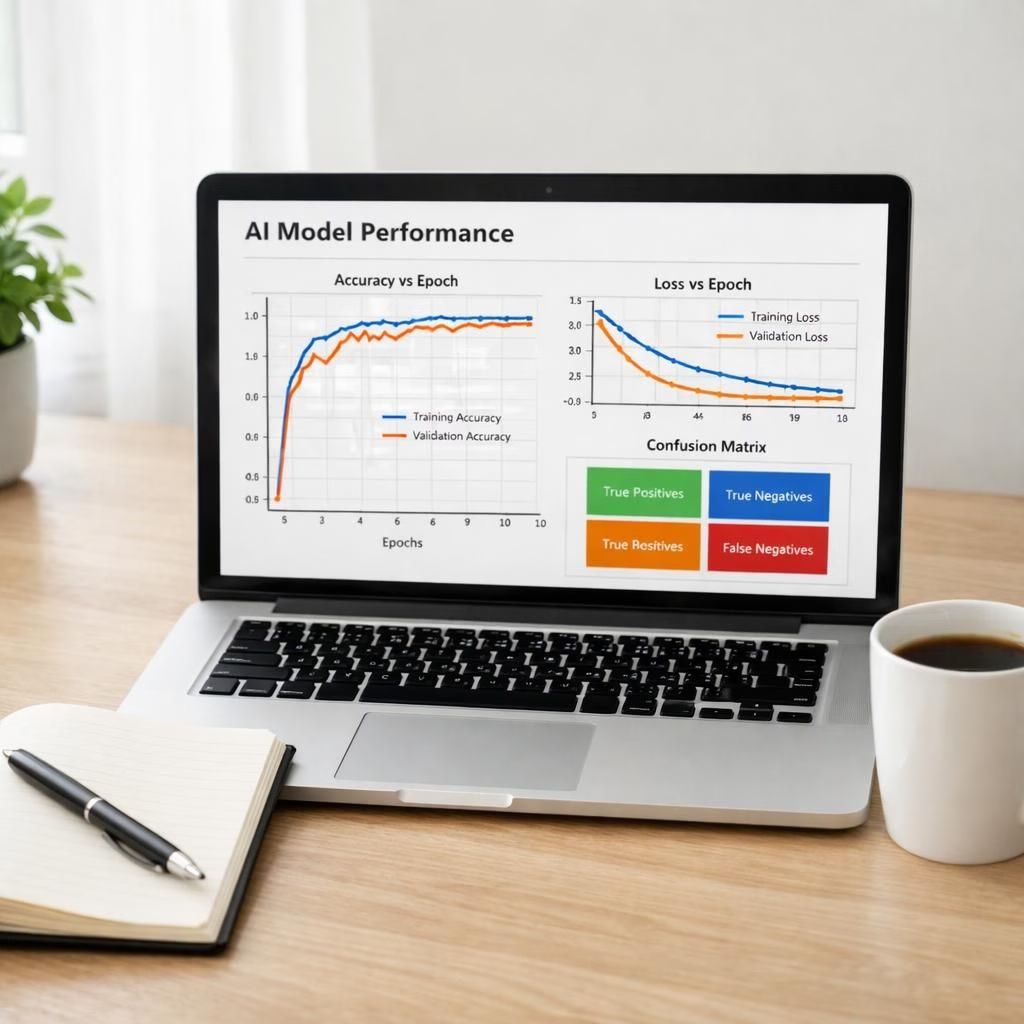
In 2026, AI and Market Talks intersect in a way that tech watchers and executives can feel the pulse. This Dow Jones Market Talks roundup scans the AI scene with practical eyes. Moonshot AI has released the Kimi K3 model, a potential DeepSeek moment, and the bigger arc promises a healthier ecosystem where performance meets price. Market Talks signals that Moonshot’s launch nudges hardware and infrastructure players toward cheaper, smarter AI. The takeaway is clear: AI progress continues, and the ecosystem adapts.
Some readers will wonder how such shifts play out in 2026. The answer is simple: experiments move faster when cost friction lowers. Teams can prototype, compare, and iterate, then decide to scale. The market rewards clarity: a model that saves compute without sacrificing utility becomes a preferred option. That is the sweet spot Moonshot seeks, and Market Talks tracks the progress with a crisp, no-nonsense lens.
AI insights from Market Talks about Moonshot Kimi K3
Kimi K3 offers a competitive, lower-cost alternative that could trim margins on heavy AI stacks. Morningstar quotes suggest it isn’t yet near parity with frontier models like Fable 5, but it shows the push to democratize access to high performance AI. The open-weight versus closed-model debate continues. Benchmark bragging can distort real-world performance, and Moonshot’s approach helps the broader AI community see a price-performance curve that teams can chase. In practical terms, this means more groups can run serious experiments without burning cash on compute. For investors and engineers, the lesson is simple: watch the pacing, not just the scores, because AI progress still matters even when costs fall.
Market Talks notes on Tencent, Dassault, and open-source AI shifts
Market Talks watchers read Tencent’s valuation dip as a temporary wobble, according to Bernstein. The note flags concerns about a slower game slate and AI spend. The logic is that AI rollouts imply higher computing costs, while consumer monetization remains modest now but could catch up later. The net: cost curves bend downward with scale, and Tencent could stay ahead with disciplined investments. Dassault Systemes’ potential ArisGlobal buy would extend Medidata’s life-sciences platform into an AI-augmented future. Citi’s Balajee Tirupati and Pavan Daswani remind readers that markets favor direct returns, yet a deal would broaden presence in a growth segment where AI plays a bigger role.
China’s AI strategy dominates Beijing’s agenda as Xi attends the World Artificial Intelligence Conference. Enodo Economics’ Diana Choyleva says Beijing sees AI as a lever for growth, industrial upgrading, and geopolitical influence. Open-source models are pitched as lower-cost options, but data, content, and commercial applications remain tightly controlled. The tension is real: openness versus governance shapes AI’s global reach.
WiseTech Global draws attention from Bell Potter. The view is cautiously optimistic about fiscal 2026 guidance. Leadership changes could reduce earnings risks in the coming months. In short, governance and strategy matter for tech stock resilience.
China’s push to embed AI into tangible applications shows up at the World Artificial Intelligence Conference. Baidu’s DuMate general-purpose agent can search information, write code, and build apps. Kingsoft Cloud’s WPS Lingxi acts as an AI office assistant. A handful of robots demonstrated AI in manufacturing, daily life, and entertainment. The display makes a simple point: AI remains a practical tool, not a futuristic fantasy.
Across all these threads, the market’s rhythm is clear. AI progress should translate into cheaper, easier deployments and stronger business value. Market Talks keeps the lens on cost, capability, and cadence.
Readers are invited to share their thoughts in the comments about how affordable high-performance AI changes the competitive landscape for hardware players, cloud providers, and software developers. Your view helps shape the next Market Talks in 2026 and beyond.
Attribution: Thanks to Dow Jones Newswires for the original Market Talks coverage. Original Market Talks coverage on Dow Jones Newswires: Dow Jones Market Talks coverage.
Practical steps for evaluating AI deployments
Use this simple framework to compare Moonshot Kimi K3-style options and similar models:
- Define the use case and required latency for your application.
- Compare cost per inference, not just model size or headline benchmarks.
- Test on representative data; track accuracy, reliability, and safety metrics.
- Design a modular stack that lets you swap components as needs evolve.
What this means for AI ecosystems and hardware players
Lower costs and better performance open doors for hardware suppliers, cloud providers, and software developers. The landscape shifts toward flexible, pay-as-you-go AI stacks that scale with demand. Market players will focus on efficiency, tooling, and governance to stay competitive. The result is more experimentation, faster adoption, and clearer paths to value. Market Talks suggests cost-effective deployments win more customers in 2026.
AI-focused checklist for teams
- Set realistic KPIs and desired business outcomes.
- Map the data, compute, and latency needs to specific tasks.
- Plan a phased rollout with measurable milestones and safety controls.
- Keep governance and security at the center of experimentation.
FAQ: AI and Market Talks in 2026
- What is the Moonshot Kimi K3 model, and why does it matter?
- It aims to deliver high performance at a lower cost, broadening access to advanced AI capabilities.
- How does Market Talks influence investor sentiment?
- It tracks cost, cadence, and real-world applicability, helping readers gauge practical value beyond hype.
- Where can I learn more about Market Talks coverage?
- See Dow Jones Market Talks coverage and related postings, including the linked sources in this article.